Built for Atlantic Canada: Why Metal Roofing Handles Our Weather
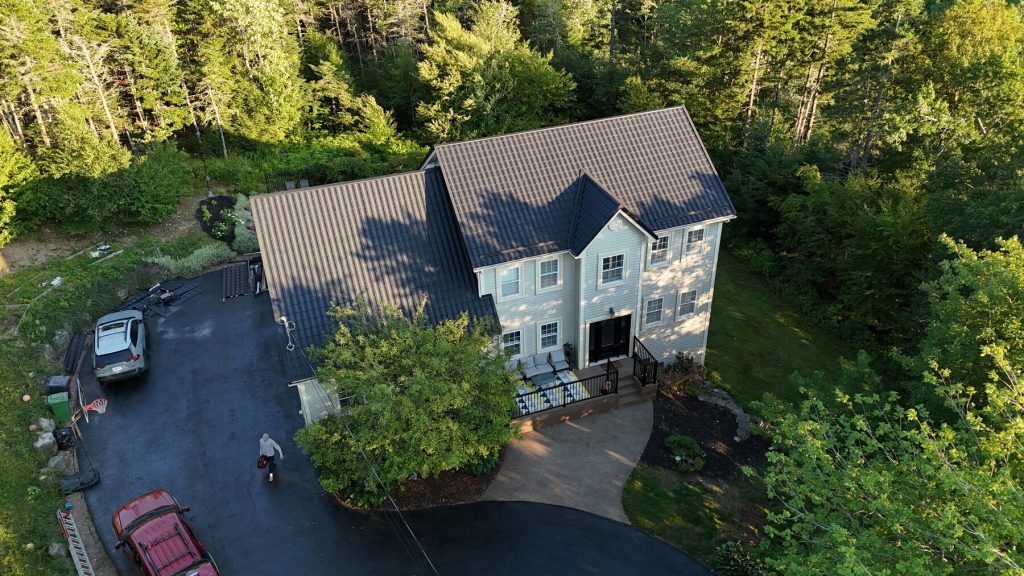
From hurricane-force winds to heavy wet snow, freeze–thaw and salt air, few places in the country test a roof the way Atlantic Canada does. Here is why a properly built metal roof is engineered to take our weather — and keep protecting your home for decades.
The weather a roof faces in Nova Scotia
Atlantic Canada asks more of a roof than almost anywhere in Canada. Over a single year, the same roof can be hit by:
- Post-tropical storm and hurricane winds. When Hurricane Fiona tracked across the region in September 2022, Arisaig, Nova Scotia recorded a wind gust of 179 km/h (111 mph), and Fiona bottomed out at 932.7 mbar — the lowest pressure ever measured for a landfalling storm in Canada. It became the costliest weather event in Atlantic Canada’s history, cut power to roughly 80% of Nova Scotia, and damaged or destroyed more than 100 homes.
- Heavy, wet snow and ice. Coastal snow is dense and heavy, and it loads a roof far more than dry inland powder — while ice builds up at the eaves and in the valleys.
- Freeze–thaw cycling. Our winter temperatures swing above and below zero over and over. Every cycle that works water into a roofing material and freezes it is a cycle that pries that material apart.
- Salt air. Near the coast, salt-laden air works constantly on every exposed fastener, flashing and finish.
- Driving rain. Wind-driven rain finds any gap a roof leaves open, especially around fasteners, seams and flashings.
A roof that merely survives a mild summer is not the same as a roof built for this. That difference is exactly where metal earns its place.
Wind: a roof that stays on when it matters
Most asphalt shingle roofs fail in a storm the same way. Shingles are fastened only along their top edge, so once the wind lifts the bottom edge it peels them off a row at a time — and once a few are gone, water pours in.
A quality metal roof is built to do the opposite. Interlocking panels and concealed clips lock every panel to the next and to the deck, leaving no exposed edge for the wind to grab. Standing-seam metal systems installed this way carry wind ratings of up to about 150 mph (240 km/h) — comfortably above the strongest gusts Fiona produced — with no exposed screws to loosen and back out over years of wind cycling.
Snow and ice: shed it, don’t hold it
Metal has a smooth, hard surface, so snow slides off instead of piling up for weeks. That keeps the structural snow load on your roof lower, and it reduces the freeze-and-melt cycle at the eaves that creates ice dams — the ridges of ice that back water up under a roof and into your ceilings.
Freeze–thaw is where shingles quietly lose the battle. An asphalt shingle is a porous mat covered in granules; water works into the surface, freezes, expands and slowly breaks it down, and every storm strips away more of the protective granules. Metal has no granules to lose and does not absorb water, so the same winter that ages a shingle roof barely touches it. Pairing the roof with properly sized seamless gutters and downspouts keeps that shed snow-melt moving safely away from your walls and foundation.
Salt air and the coast
Corrosion is the quiet killer of coastal roofs, so the material matters. Quality metal panels start with Galvalume steel — steel coated in an aluminum-zinc alloy engineered specifically to resist corrosion — and are finished with a Kynar 500 / PVDF coating that holds its colour and shrugs off salt air, UV and pollution for decades. That is a very different story from bare or cheaply coated metal, and a world away from shingles that simply weather and fade.
A roof that outlasts the weather
All of this adds up to longevity. In our climate, asphalt shingles typically last 15 to 25 years — often at the shorter end with coastal wind and salt exposure — while a properly installed metal roof is built to last 40 to 60 years or more, commonly backed by a 40- to 50-year warranty. Over the life of a home that is often one metal roof instead of two or three shingle roofs.
Metal also works for your energy bill: its finish reflects summer heat to keep your attic cooler, and paired with good insulation it helps hold warmth through our long winters. You can get a preliminary price for your own roof in minutes with our online estimator.
How WB Construction builds for Atlantic Canada
Materials only protect you if they are installed correctly, so every project starts the same way: we come out and inspect your roof in person before we quote anything. From there we build with the premium Finnish VANKKA Classic system — metal engineered for a harsh northern climate — in either standing seam or metal tile, always with concealed fasteners and a Kynar 500 finish.
Where it makes sense, we can install your new metal roof straight over your existing shingles with our Direct-Over-Deck method — no full tear-off, less mess, and real savings on materials, without giving up any of the wind, snow or corrosion protection above.
If you are ready to leave high-maintenance shingles behind, start with a free roof inspection and quote. We will look at your roof, your exposure and your budget, and show you exactly what a roof built for Atlantic Canada looks like on your home.
Storm facts (wind gust, pressure record and damage figures for Hurricane Fiona, September 2022) are drawn from Environment and Climate Change Canada data and the U.S. National Hurricane Center’s tropical cyclone report.